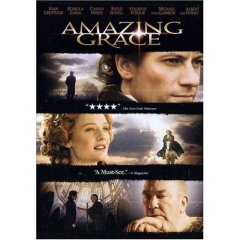
Amazing Grace is a historical drama about William Wilberforce who was elected to British Parliament at the age of 21 in 1780. Because of his deep religious beliefs he became one of the leading English abolitionists against the British slave trade.
The movie follows his religious conversion in 1785 when he prepared to leave politics to enter the clergy but was convinced by his friend William Pitt, the future Prime Minister, to stay in Parliament because he could use his oratory “to praise the Lord or change the world”. Wilberforce was opposed to Britain's thriving slave trade, and with the help of prominent abolitionists of the era (Thomas Clarkson, Olaudah Equiano and John Newton) fought an uphill 20 year battle to eventually abolish the English slave trade in 1807. In this film, it is John Newton—a former slave ship captain and the author of the hymn "Amazing Grace"—who convinces his friend Wilberforce to take up the cause and encourages him along the way. Amazing Grace is an inspiring movie about one man's response to injustice. This movie is an example for us to leave our comfort zone and by faith use our God-given opportunities to change the world for good.
William Wilberforce's relentless campaign eventually led the British Parliament to ban the slave trade, in 1807, and to pass a law shortly after his death in 1833, making the entire institution of slavery illegal. But it is impossible to understand Wilberforce's long antislavery campaign without seeing it as part of a larger Christian impulse. The man who prodded Parliament so famously also wrote theological tracts, sponsored missionary and charitable works, and fought for what he called the "reformation of manners," a campaign against vice. This is the Wilberforce that Mr. Apted has played down.
And little wonder. Even during the 18th century, evangelicals were derided as over-emotional "enthusiasts" by their Enlightenment-influenced contemporaries. By the time of Wilberforce's "great change," liberal 18th-century theologians had sought to make Christianity more "reasonable," de-emphasizing sin, salvation and Christ's divinity in favor of ethics, morality and a rather distant, deistic God. Relatedly, large numbers of ordinary English people, especially among the working classes, had begun drifting away from the tepid Christianity that seemed to prevail. Evangelicalism sought to counter such trends and to reinvigorate Christian belief.
Perhaps the leading evangelical force of the day was the Methodism of John Wesley: It focused on preaching, the close study of the Bible, communal hymn-singing and a personal relationship with Jesus Christ. Central to the Methodist project was the notion that good works and charity were essential components of the Christian life. Methodism spawned a vast network of churches and ramified into the evangelical branches of Anglicanism. Nearly all the social-reform movements of the 19th and early 20th centuries -- from temperance and soup kitchens to slum settlement houses and prison reform -- owe something to Methodism and its related evangelical strains. The campaign against slavery was the most momentous of such reforms and, over time, the most successful.
It is thus fitting that John Wesley happened to write his last letter -- sent in February 1791, days before his death -- to William Wilberforce. Wesley urged Wilberforce to devote himself unstintingly to his antislavery campaign, a "glorious enterprise" that opposed "that execrable villainy which is the scandal of religion, of England, and of human nature." Wesley also urged him to "go on, in the name of God and in the power of his might, till even American slavery (the vilest that ever saw the sun) shall vanish away before it."
Wesley had begun preaching against slavery 20 years before and in 1774 published an abolitionist tract, "Thoughts on Slavery." Wilberforce came into contact with the burgeoning antislavery movement in 1787, when he met Thomas Clarkson, an evangelical Anglican who had devoted his life to the abolitionist cause. Two years later, Wilberforce gave his first speech against the slave trade in Parliament.
As for the hymn "Amazing Grace," from which the film takes its name, it is the work of a friend of Wilberforce's named John Newton (played in the movie by Albert Finney). Newton had spent a dissolute youth as a seaman and eventually became a slave-ship captain. In his 20s he underwent a kind of spiritual crisis, reading the Bible and Thomas à Kempis's "Imitation of Christ." A decade later, having heard Wesley preach, he fell in with England's evangelical movement and left sea-faring and slave-trading behind. Years later, under the influence of Wilberforce's admonitions, he joined the antislavery campaign. The famous hymn amounted to an autobiography of his conversion: "Amazing grace . . . that saved a wretch like me." In the most moving moment of the film -- and one of the few that addresses a Christian theme directly -- the aged and now-blind Newton declares to Wilberforce: "I am a great sinner, and Christ is a great savior."
This idea of slaving as sin is key. As sociologist Rodney Stark noted in "For the Glory of God" (2003), the abolition of slavery in the West during the 19th century was a uniquely Christian endeavor. When chattel slavery, long absent from Europe, reappeared in imperial form in the 16th and 17th centuries -- mostly in response to the need for cheap labor in the New World -- the first calls to end the practice came from pious Christians, notably the Quakers. Evangelicals, not least Methodists, quickly joined the cause, and a movement was born.
Thanks to Wilberforce, the movement's most visible champion, Britain ended slavery well before America, but the abolitionist cause in America, too, was driven by Christian churches more than is often acknowledged. Steven Spielberg's 1997 "Amistad," about the fate of blacks on a mutinous slave ship, also obscured the Christian zeal of the abolitionists.
Nowadays it is all too common -- and not only in Hollywood -- to assume that conservative Christian belief and a commitment to social justice are incompatible. Wilberforce's embrace of both suggests that this divide is a creation of our own time and, so to speak, sinfully wrong-headed. Unfortunately director Apted, as he recently told Christianity Today magazine, decided to play down Wilberforce's religious convictions -- that would be too "preachy," he said -- and instead turned his story into a yarn of political triumph. The film's original screenwriter, Colin Welland, who wrote the screenplay for the acclaimed and unabashedly Christian "Chariots of Fire," was replaced.
The movie "Amazing Grace" nods occasionally in the direction of granting a role to faith in social reform, but it would do us all well to supplement our time in the movie theater by doing some reading about the heroic and amazing Christian who was the real William Wilberforce.